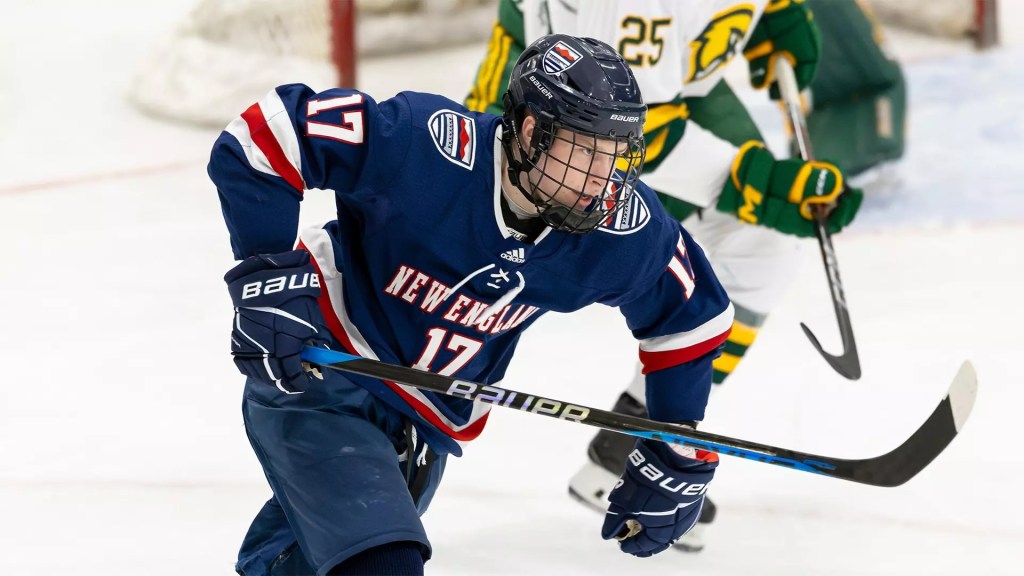
Elite Hockey Academy is proud to recognize Egor Osipik, EHA alumnus and current student-athlete at New England College, for his continued success at the collegiate level, where he is leading his team in points and earning conference recognition.
To give our community an inside look at his journey, we asked Egor a series of questions about his time at Elite Hockey Academy, his transition to college hockey, and the lessons he’s learned along the way. Here’s what he had to say:
Full Interview with Egor Osipik
Experience at Elite Hockey Academy
Q: Can you describe your experience at the Elite Hockey Academy? What were some of the key takeaways that stood out to you?
A: Looking back at my time at EHA, I realize how amazing those two years were for me. Connecticut and Elite became a second home after moving across the world. I learned about life in the United States, met amazing people, and played hockey at a very high level. There’s a lot to say about my journey at Elite, but the biggest takeaways for me were the memories I made and the relationships I built. I will always cherish my time here.
Preparation for the Next Level
Q: How did the training and environment at the Academy prepare you for the next steps in your hockey career?
A: The overall structure of the academy is very similar to college. High school and college schedules are a bit different, but everything related to playing hockey is almost the same at both levels. A big factor that helped me improve was playing around 60 games a year. When you play that many games, you develop a sense of what to do in every situation on the ice. Knowing how to execute in all areas of the rink prepares you for the next level, where players are stronger, faster, and smarter. It’s also pretty cool now to see familiar faces on the ice that I remember playing with or against at Elite.
Transition to College Hockey
Q: What was the transition like for you moving from the 18U Elite Hockey Academy to competing at the collegiate level?
A: Honestly, the transition was pretty smooth for me. The daily structure and training are very similar, so I felt well-prepared. The biggest difference was that the college season starts later and you only play about 25 games a year compared to 60 at the 18U level.
Q: Were there any specific challenges you faced, and how did you overcome them?
A: Every time you change teams or levels, you have to prove yourself every day and show that you deserve a spot in the lineup. My college career started with tryouts, with a lot of freshmen competing for roster spots. It took me a couple of months to adjust to the new level and show that I could consistently make plays. The first half of last season was also tough for us as a team – we only won two of our first ten games. We talked things through and worked extremely hard over winter break, and by the end of the season we reached the conference semifinals and played against the national champion.
Current Achievements at New England College
Q: Congratulations on leading your team in points. What do you think has contributed to your success this season?
A: Thank you. Other than the work we put in at practice, I think the biggest factor has been finding chemistry with my linemates. We know where each other will be in every situation, and we don’t even have to look before passing. Another important factor is going to the net. That’s the area where games and trophies are won, and it’s something I try to focus on more. As a team, we struggled with that early in the season, but it’s getting better every game and it’s starting to pay off.
Q: How does it feel to have been recognized as Pilgrim of the Week? What does this honor mean to you?
A: It always feels good to be recognized, and I really appreciate it. My goal is to be consistent and perform at that level every week, or help my teammates do the same. I want people to expect that someone from our men’s hockey team will earn that award each week.
Balancing Life as a Student-Athlete
Q: How do you manage the balance between academics and athletics at New England College?
A: College is very different from high school or juniors, and creating my own structure helps me manage everything. Every semester takes a couple of weeks to adjust, but once you get into a routine, time really flies. Once I get into a flow state, it feels like I’m counting the weeks by Fridays because I can’t wait to play each weekend. In college hockey, you only play about 25 games a season, so if you want to compete for a trophy in March, you have to dig in right away.
Q: Can you share any strategies that have helped you excel both in the classroom and on the ice?
A: I have a daily plan for each day that helps me focus on the tasks I need to complete and the goals I want to achieve. The biggest thing, in my opinion, is listening to both professors and coaches. If you listen to them, understand what needs to be done and how to do it, there’s no reason you should fail an exam or get scratched from the lineup.
Future Aspirations
Q: What are your goals moving forward in your hockey career, both at New England College and beyond?
A: I want to win as many games as possible in the second half of the season so we have a chance to compete for a conference championship and move on to the NCAA tournament. I also want to improve my game in all areas of the ice and become a full-ice player. In a nutshell, my goal is to win every day.
Q: Do you have any thoughts about pursuing a professional career in hockey after college?
A: Yes, I would love to play professionally after college. I still have a couple of years to show my best, help my team win, and hopefully prove my value so that professional teams take notice.
Advice for Current Elite Hockey Academy Players
Q: What advice would you give to current students at the Elite Hockey Academy who aspire to play at the collegiate level?
A: My advice would be to listen to what you’re asked to do and execute the basics that are required at every level. If you take care of the details, you can be successful at any level you play.
Q: Looking back, is there anything you would have done differently during your time at the Academy?
A: My biggest regrets are probably our performances in league playoffs both years. We were so close to championships in both PPHL and AYHL, but we didn’t play the way we were capable of. To this day, those losses still sting, and I wish I could go back and replay those games.
Closing Thoughts
Q: Is there anything else you would like to add about your journey, your time at Elite Hockey Academy, or your current experience as a student-athlete?
A: I’m very thankful that I made the decision to come to Elite. I had two unforgettable years here, learned a lot, and grew both as a person and as a player. Elite Hockey Academy opened the path to my hockey career in the United States, and it will always have a special place in my heart.